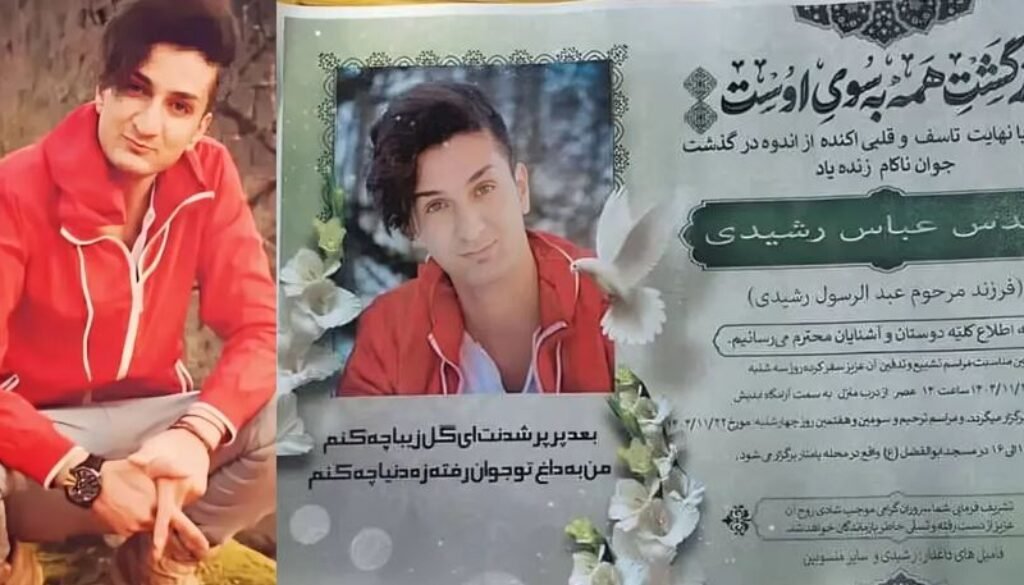
Abbas Rashidi: A Wounded Protester Killed in Custody
According to information obtained by IranWire, Abbas Rashidi, 35, was wounded by pellet fire during the Semirom protests on Thursday, January 8. Days later, after security agents put pressure on his family, he was detained and later killed in custody.
One of Abbas’s friends told IranWire: “After being injured by the pellets, he left Semirom at night and went to a friend’s house in Baharestan, Isfahan. However, due to pressure from security agents on his family, he turned himself in to Police Station 22 in Baharestan on February 4.”
According to those close to Abbas, security agents arrested his brother to pressure the family into forcing Abbas to surrender. Only a few days later, his body was returned to them.
Hostage-taking of family members is a well-known tactic used by Iranian intelligence to force fugitives or wounded protesters out of hiding. By arresting a sibling or parent, the state puts protesters in an unbearable position – surrender to protect their family, only to risk torture or death in detention.
Recalling the arrest and execution of the Bahramian brothers during the “Woman, Life, Freedom” movement, Abbas’s friend explained to IranWire: “Security agents have inflicted this kind of tragedy on the people of Semirom before by pressuring families. On November 16, 2022, following the killing of Morad Bahramian, his brothers were arrested, and after a long period of pressure, Fazel and Mehran Bahramian were eventually executed.”
The Bahramian case remains a stark example of state retribution in Semirom. Fazel and Mehran Bahramian were executed after the 2022 protests following a legal process that human rights groups described as a “sham,” based on forced confessions. For many in the town, Abbas’s death is now seen as part of a long-running pattern of punishment directed at Semirom’s residents.
According to Abbas’s friend, this young man was also present during the protests and market strikes following the arrest and execution of Fazel and Mehran Bahramian, and it appears he was a familiar face to security agents.
Abbas’s friend also pointed to another detail, saying: “During the Semirom protests, people stormed the Samen-ol-A’emmeh IRGC complex in the city. A clash broke out there, and during these clashes, an IRGC colonel named Sajjad Mirzaei was killed. The people of Semirom say that the killing of Abbas Rashidi in custody is not unrelated to the matter of this IRGC colonel.”
The IRGC, the regime’s elite military force, has a long history of responding to the killing of senior officers with retaliation. When a high-ranking figure such as a colonel is killed, deaths in custody often follow. In such cases, the killing of a protester is widely understood as an extrajudicial act, or “blood revenge,” carried out by the security apparatus.
The body of Abbas Rashidi was delivered to his family on February 9 at Behesht-e Rezvan in Isfahan and buried on February 10 in Semirom. The people of Semirom chanted slogans against the government at his funeral, including: “Until the cleric is shrouded, this homeland will not be a homeland.”
In one of the last posts on his Instagram page, he had written:
“O friend… I swear by my honor, there is neither devil nor hell. Your soul will die sooner than your body. So fear nothing anymore, and when the time of your death arrives, the one who must die is you. So live the way you love.”