The Arms Industry in Turkey: The Rise of a New Military Power
Over the past two decades, Turkey’s defense industry has undergone a fundamental transformation, turning the country from a major arms importer into one of the influential players in the global weapons market. This transformation has not only strengthened Turkey’s military standing but has also become an important instrument in its foreign policy and regional geopolitical calculations.
Historical Transformation and the Shift Toward Self-Sufficiency
Until the early 2000s, Turkey was heavily dependent on arms imports, particularly from the United States and European countries such as Germany. This dependence, especially during periods of political tension and arms embargoes, exposed Ankara’s strategic vulnerability.
In response, the Turkish government adopted a “defense self-sufficiency” strategy starting in 2004. This strategy included increasing the defense budget, making extensive investments in research and development (R&D), supporting domestic companies, and gradually reducing reliance on foreign suppliers. The result of this policy was the emergence of a dynamic industrial ecosystem in the military and security sectors.
Key Companies in Turkey’s Defense Industry
Turkey’s success in this field is largely due to its major and semi-state defense companies:
-
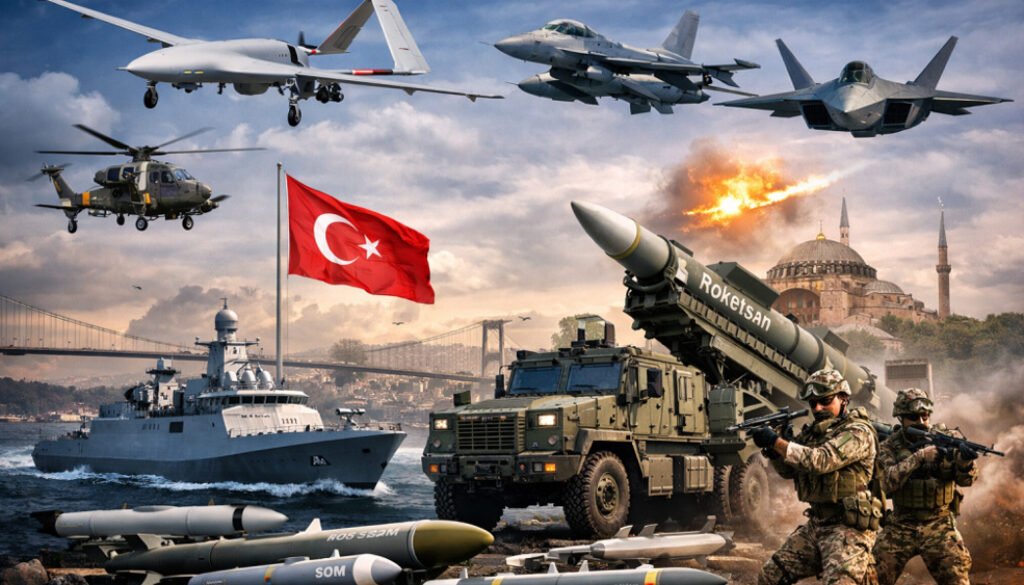
Turkish Aerospace Industries (TAI): One of the main pillars of Turkey’s military aerospace industry, playing a central role in the production of unmanned aerial vehicles, helicopters, and the national KAAN fighter jet.
-
ASELSAN: A leader in defense electronics, radar systems, electronic warfare, and military communications.
-
ROKETSAN: Specializes in the production of missiles, rockets, and advanced guided munitions.
-
Major defense holdings: Structures encompassing more than ten subsidiary companies, covering a wide range of land, naval, and aerial military equipment.
Flagship Products and Military Capabilities
Turkey’s defense industry has achieved notable accomplishments across various domains:
-
Unmanned Aerial Vehicles (UAVs): The Bayraktar series, especially the TB2, has become a symbol of Turkey’s military technological power, with a successful operational record in regional conflicts.
-
Armored Vehicles: Production of various MRAP vehicles and modern armored platforms designed to counter asymmetric threats.
-
Naval Forces: The national MILGEM project, which has resulted in the construction of indigenous corvettes and warships.
-
Fighter Aircraft: The national KAAN fighter jet project, aimed at enabling Turkey to join the club of fifth-generation fighter aircraft manufacturers.
Export Strategy and Defense Diplomacy
By adopting a policy of “defense diplomacy,” Turkey has turned arms exports into a tool for increasing its political and security influence. Azerbaijan, Ukraine, Qatar, Morocco, and Pakistan are among the main buyers of Turkish military equipment.
The value of Turkey’s defense exports has increased from about $248 million in 2002 to over $4.5 billion in 2023, reflecting the sector’s remarkable growth.
Key Factors Behind Success
Several major factors have contributed to the success of Turkey’s arms industry:
-
Sustained and substantial investment in research and development (over $1.5 billion annually)
-
Close cooperation between the government, the military, and the private sector
-
Gaining real operational experience on the battlefields of Syria, Libya, and Nagorno-Karabakh
-
Offering products at competitive prices compared to American and European counterparts
Challenges and Limitations
Despite these advances, Turkey’s defense industry still faces several challenges:
-
Restrictions on technology transfer imposed by some NATO allies
-
Dependence on imports for certain critical components, particularly aircraft engines and advanced systems
-
Intense competition with traditional giants of the global defense industry
-
The risk of political sanctions and geopolitical pressure
Future Outlook
By implementing ambitious projects such as the fifth-generation KAAN fighter jet, the T929 attack helicopter, and the development of coastal defense and missile defense systems, Turkey aims to rank among the world’s top ten defense industry countries in the coming decade.
Overall, by turning regional security threats into industrial and technological opportunities, Turkey has not only largely met its own defense needs but has also become an influential player in geopolitical calculations and the global arms market.